Dhinowda City Story
A coastal town, its old way of life, the moving sand, and what can still be saved.
A town the sand is trying to take
Dhinowda is a coastal community in Mudug Region, Puntland, on the Indian Ocean. For generations it lived from the sea, from livestock and from trade. Today moving sand dunes are slowly covering the town.
This page tells the story in fifteen short parts: where Dhinowda sits, how people lived before, how the dunes began to move, what has been lost, and what the district still believes can be saved.
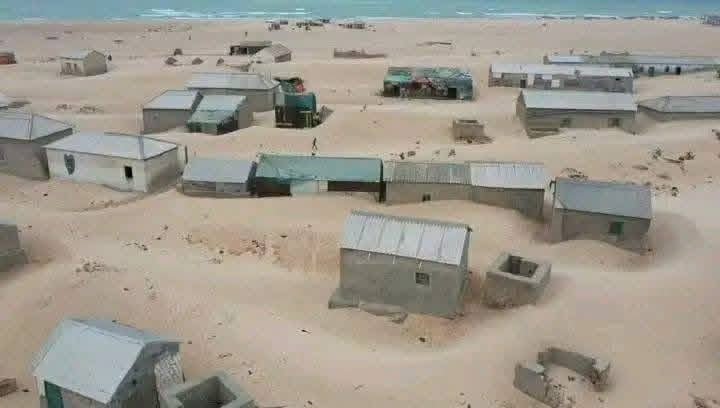 Dhinowda — homes standing in open dune sand, beside the ocean
Dhinowda is more than a point on a map. It is a home, a community, a history and a living for thousands of Somali families. The sand cannot be negotiated with, but it can be held back.
- RegionMudug, Puntland, Somalia
- CoastIndian Ocean
- Position6.73° N, 49.20° E
- DistrictReported within Jariiban District
- PeopleThousands of residents and families
- Living fromFishing, livestock, small trade
What the reports from Dhinowda say
These numbers come from news reporting on Dhinowda between 2021 and 2023. They are not a DDA survey.
Dhinowda, told in order
From the coast and the old way of life, through the dunes and the water crisis, to what can still be built.
Read the development plan-
01
Where Dhinowda sits
Dhinowda lies on the Mudug coastline of central Somalia, beside the Indian Ocean. The coast has long given families fishing and trade, while the land behind it carried livestock and homes. The same wind and open sand that shaped the place now carry huge amounts of sand toward houses, roads and public buildings.
-
02
The people of Dhinowda
Dhinowda is home to thousands of residents and families. There is no recent official census for the town, so DDA does not publish a single population number. News reporting has described the community as a few thousand families.
-
03
Life before the sand
Before the sand became a threat, families lived beside the sea and lived from it. Fishermen went out, women handled and sold the catch, traders brought goods, and herders moved animals through the area. Children played in the streets and small shops served the town.
-
04
How the problem began
The crisis did not arrive in one day. For years people watched sand creep across the coast. Strong seasonal winds, long drought and lost vegetation turned a seasonal nuisance into a danger to the whole town.
-
05
When the sand took the streets
Sand began entering homes. At first people swept it from doorways and dug it away from walls. But it kept coming back. Reports describe families clearing sand from their houses three or four times in a single day.
-
06
Homes lost under the dunes
The hardest loss has been homes. In 2021 about 300 families were reported displaced after dunes buried houses in Dhinowda. Losing a house means losing belongings, memories, neighbours, and the place where children were raised.
-
07
The water crisis
Sand has buried wells as well. Reporting from the area says 12 wells were covered, pushing families to buy water brought from far away. When water is hard to reach, food, health, livestock and small businesses all suffer.
-
08
Roads and food supply
Sand blocks roads and makes transport slow and costly. In 2023 food trucks from Bosaso could no longer enter the settlement and left supplies at the edge of the village. Isolation raises prices and makes medicine and building materials harder to get.
-
09
Fishing under pressure
Fishing has always been a main living on this coast. Hard seasons, damaged shelters and displacement now make it harder to keep boats and gear working. The sea is still there, but earning from it has become difficult.
-
10
The human cost
Behind every dune there is a person. A mother watching sand come through the door. A fisherman who cannot go out. A child whose school yard is gone. An elder asked to leave a lifetime home. A shopkeeper with no customers left.
-
11
The past must not be forgotten
Dhinowda should not be remembered only as a town under sand. It is a community of fishermen, herders, traders, elders, women, children and young people. Its old homes, wells and meeting places carry the history of families who built their lives here.
-
12
A community that will not give up
People keep living, working and rebuilding. They clear sand from homes and roads again and again, search for water, and look for ways to keep the town connected. Dhinowda is not a place without hope. It is a place waiting for organised support.
-
13
The DDA vision
DDA was formed to answer this in an organised way. The goal is not only to move today's sand. The goal is a Dhinowda that can stand up to tomorrow's weather.
-
14
From clearing sand to lasting protection
Clearing sand is an emergency answer, not a cure. Dhinowda needs vegetation barriers, dune stabilisation, controlled clearing, road protection, local environment committees, and steady watching of how the dunes move.
-
15
The future of Dhinowda
The story does not have to end in disappearance. Roads can be reopened, homes protected, wells recovered, fishing strengthened and young people employed. A town threatened by sand can become Somalia's model for coastal resilience.
Four steps, in this order
Sand removal alone is not a solution. It is only the first step of four.
Eleven things Dhinowda needs
This is the working list the agency was set up to carry out, with the district and its partners.
Support the work- Remove sand from roads and homes
- Protect homes and public buildings
- Restore and protect water sources
- Plant trees and ground cover
- Build lasting sand-control works
- Improve roads and town services
- Support fishing and marine work
- Create jobs, above all for youth
- Stand with the most vulnerable families
- Teach care of the environment
- Bring in investment and partners
Dhinowda must not disappear under the sand
Give, partner or volunteer. Every gift is written down and reported back to the district.